Sample, n.
Etymology: [OE. sample, asaumple, OF. essample, example, fr. L. exemplum. See Example, and cf. Ensample, Sampler.]
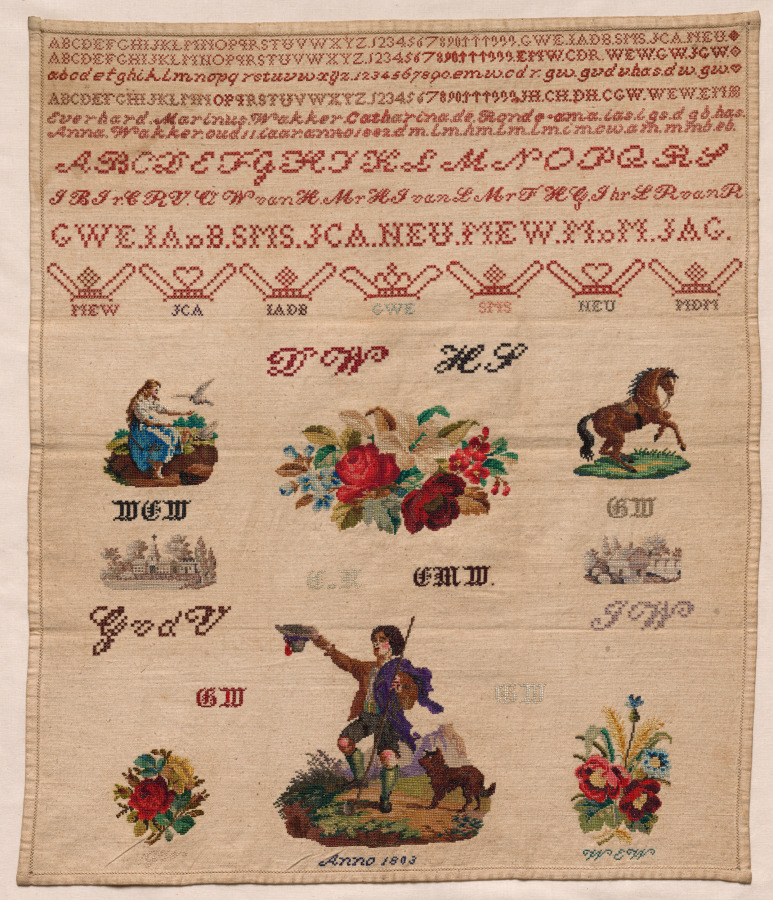
A sampler: a girl stitched a sample of every letter and pattern she had learned.
Sampler, Anna Wakker (Dutch, 1871–1917), 1882. Cleveland Museum of Art.1. Example; pattern. [Obs.] Spenser. "A sample to the youngest." Shak. Thus he concludes, and every hardy knight His sample followed. Fairfax.
2. A part of anything presented for inspection, or shown as evidence of the quality of the whole; a specimen; as, goods are often purchased by samples. I design this but for a sample of what I hope more fully to discuss. Woodward.
Syn. -- Specimen; example. See Specimen.
1 other Webster entry under this spelling
Sample, v. t.
1. To make or show something similar to; to match. Bp. Hall.
2. To take or to test a sample or samples of; as, to sample sugar, teas, wools, cloth.
Shades of meaning
A sample is a portion taken at random out of a quantity supposed to be homogeneous, so that the qualities found in the sample may reasonably be expected to be found in the whole; as, a sample of sugar; a sample of cloth. A specimen is one unit of a series, or a fragment of a mass, all of which is supposed to possess the same essential qualities; as, a specimen of coinage, or of architecture, or a specimen of quartz. No other unit or portion may be exactly like the specimen, while all the rest is supposed to be exactly like the sample. An instance is a sample or specimen of action. Compare example.