Quote, v. t. [imp. & p. p. Quoted; p. pr. & vb. n. Quoting.]
Etymology: [OF. quoter, F. coter to letter, number, to quote, LL. quotare to divide into chapters and verses, fr. L. quotus. See Quota.]
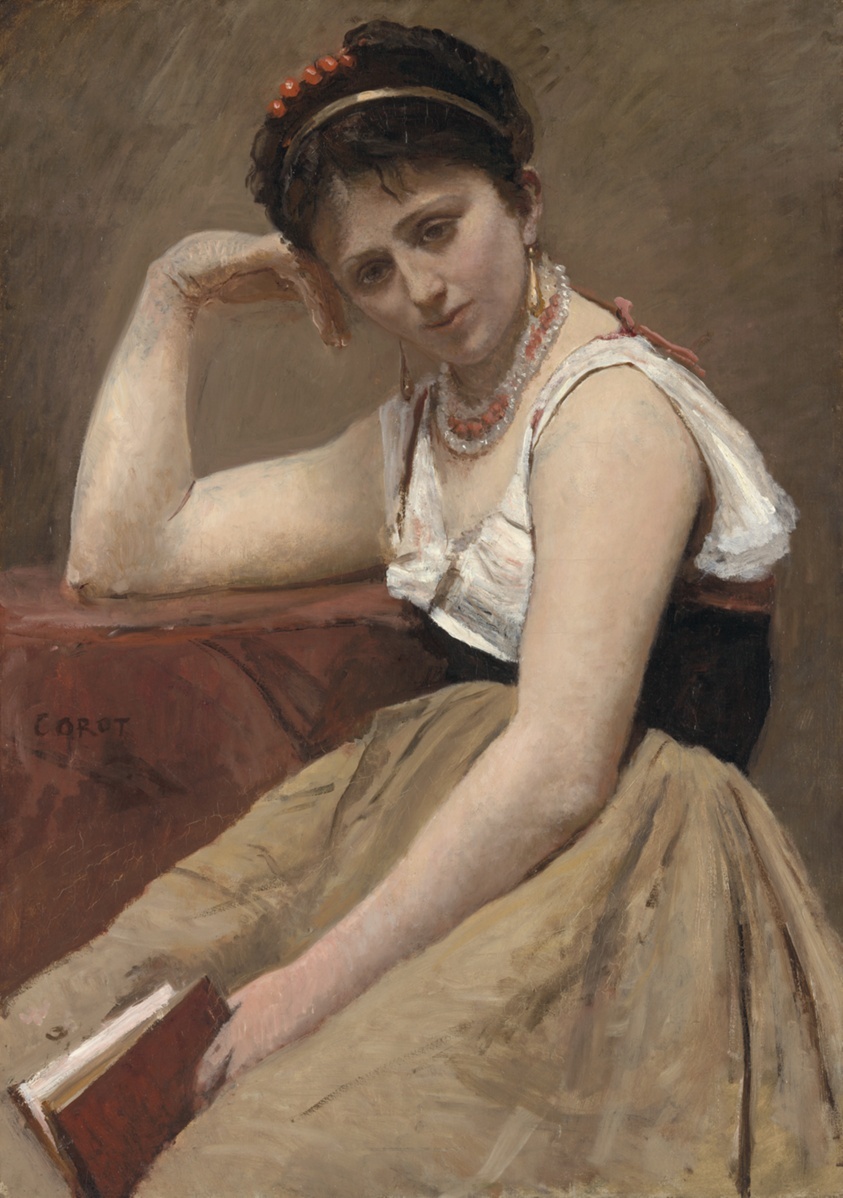
She holds her place in the book with a finger. To quote is to repeat someone else's words.
Interrupted Reading, Jean Baptiste Camille Corot, c. 1870. Art Institute of Chicago.[Formerly written also cote.]
1. To cite, as a passage from some author; to name, repeat, or adduce, as a passage from an author or speaker, by way of authority or illustration; as, to quote a passage from Homer.
2. To cite a passage from; to name as the authority for a statement or an opinion; as, to quote Shakespeare.
3. (Com.)
4 more senses
To name the current price of.
4. To notice; to observe; to examine. [Obs.] Shak.
5. To set down, as in writing. [Obs.] "He's quoted for a most perfidious slave." Shak.
Syn. -- To cite; name; adduce; repeat. Quote, Cite. To cite was originally to call into court as a witness, etc., and hence denotes bringing forward any thing or person as evidence. Quote usually signifies to reproduce another's words; it is also used to indicate an appeal to some one as an authority, without adducing his exact words.
1 other Webster entry under this spelling
Quote, n.
A note upon an author. [Obs.] Cotgrave.
Shades of meaning
To quote is to give an author's words, either exactly, as in direct quotation, or in substance, as in indirect quotation; to cite is, etymologically, to call up a passage, as a witness is summoned. In citing a passage its exact location by chapter, page, or otherwise, must be given, so that it can be promptly called into evidence; in quoting, the location may or may not be given, but the words or substance of the passage must be given. In citing, neither the author's words nor his thought may be given, but simply the reference to the location where they may be found. To quote, in the proper sense, is to give credit to the author whose words are employed. To paraphrase is to state an author's thought more freely than in indirect quotation, keeping the substance of thought and the order of statement, but changing the language, and commonly interweaving more or less explanatory matter as if part of the original writing. One may paraphrase a work with worthy motive for homiletic, devotional, or other purposes (as in the metrical versions of the Psalms), or he may plagiarize atrociously in the form of paraphrase, appropriating all that is valuable in another's thought, with the hope of escaping detection by change of phrase. To plagiarize is to quote without credit, appropriating another's words or thought as one's own. To recite or repeat is usually to quote orally, tho recite is applied in legal phrase to a particular statement of facts which is not a quotation; a kindred use obtains in ordinary speech; as, to recite one's misfortunes.