Food, n.
Etymology: [OE. fode, AS. foda; akin to Icel. fæ\'eba, fæ\'ebi, Sw. föda, Dan. & LG. föde, OHG. fatunga, Gr. patei^sthai to eat, and perh. to Skr. pa to protect, L. pascere to feed, pasture, pabulum food, E. pasture. 75. Cf. Feed, Fodder food, Foster to cherish.]
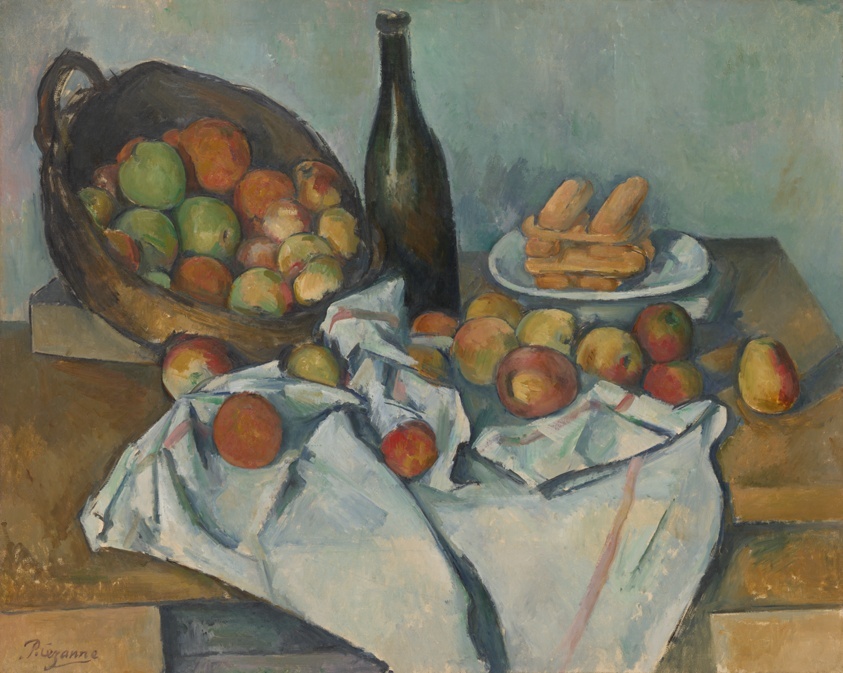
Cézanne painted apples, bread and a bottle. What would you eat first?
The Basket of Apples, Paul Cezanne, c. 1893. Art Institute of Chicago.1. What is fed upon; that which goes to support life by being received within, and assimilated by, the organism of an animal or a plant; nutriment; aliment; especially, what is eaten by animals for nourishment.
Note: In a physiological sense, true aliment is to be distinguished as that portion of the food which is capable of being digested and absorbed into the blood, thus furnishing nourishment, in distinction from the indigestible matter which passes out through the alimentary canal as fæces.
Note: Foods are divided into two main groups: nitrogenous, or proteid, foods, i.e., those which contain nitrogen, and nonnitrogenous, i.e., those which do not contain nitrogen. The latter group embraces the fats and carbohydrates, which collectively are sometimes termed heat producers or respiratory foods, since by oxidation in the body they especially subserve the production of heat. The proteids, on the other hand, are known as plastic foods or tissue formers, since no tissue can be formed without them. These latter terms, however, are misleading, since proteid foods may also give rise to heat both directly and indirectly, and the fats and carbohydrates are useful in other ways than in producing heat.
2. Anything that instructs the intellect, excites the feelings, or molds habits of character; that which nourishes. This may prove food to my displeasure. Shak. In this moment there is life and food For future years. Wordsworth.
2 more senses
Note: Food is often used adjectively or in self-explaining compounds, as in food fish or food-fish, food supply. Food vacuole (Zoöl.), one of the spaces in the interior of a protozoan in which food is contained, during digestion. -- Food yolk. (Biol.) See under Yolk.
Syn. -- Aliment; sustenance; nutriment; feed; fare; victuals; provisions; meat.
1 other Webster entry under this spelling
Food, v. t.
To supply with food. [Obs.] Baret.
Shades of meaning
Food is, in the popular sense, whatever one eats in contradistinction to what one drinks. Thus, we speak of food and drink, of wholesome, unwholesome, or indigestible food; but in a more scientific sense whatever, when taken into the digestive organs, serves to build up structure or supply waste may be termed food; the word is extended to plants to signify whatever taken in any way into the organism serves similar purposes; thus, we speak of liquid food, plant food, etc.; in this wider sense food is closely synonymous with nutriment, nourishment, and sustenance. Diet refers to the quantity and quality of food habitually taken, with reference to preservation of health. Victuals is a plain, homely word for whatever may be eaten; we speak of choice viands, cold victuals. Nourishment and sustenance apply to whatever can be introduced into the system as a means of sustaining life; we say of a convalescent, he is taking nourishment. Nutriment and nutrition have more of scientific reference to the vitalizing principles of various foods; thus, wheat is said to contain a great amount of nutriment. Regimen considers food as taken by strict rule, but applies more widely to the whole ordering of life. Fare is a general word for all table supplies, good or bad; as, sumptuous fare; wretched fare. Feed, fodder, and provender are used only of the food of the lower animals, feed denoting anything consumed, but more commonly grain, fodder denoting hay, cornstalks, or the like, sometimes called "long feed;" provender is dry feed, whether grain or hay, straw, etc. Forage denotes any kind of food suitable for horses and cattle, primarily as obtained by a military force in scouring the country, especially an enemy's country.