Attitude, n.
Etymology: [It. attitudine, LL. aptitudo, fr. L. aptus suited, fitted: cf. F. attitude. Cf. Aptitude.]
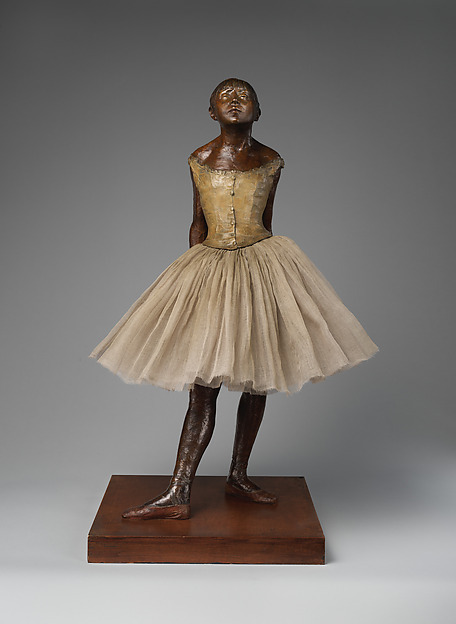
In ballet, an attitude is a pose. Look at how she holds her head and hands.
The Little Fourteen-Year-Old Dancer, Edgar Degas, modeled 1881, cast 1922, modern tutu. The Met.1. (Paint. & Sculp.)
The posture, action, or disposition of a figure or a statue.
2. The posture or position of a person or an animal, or the manner in which the parts of his body are disposed; position assumed or studied to serve a purpose; as, a threatening attitude; an attitude of entreaty.
3. Fig.: Position as indicating action, feeling, or mood; as, in times of trouble let a nation preserve a firm attitude; one's mental attitude in respect to religion. The attitude of the country was rapidly changing. J. R. Green. To strike an attitude, to take an attitude for mere effect.
1 more senses
Syn. -- Attitude, Posture. Both of these words describe the visible disposition of the limbs. Posture relates to their position merely; attitude refers to their fitness for some specific object. The object of an attitude is to set forth exhibit some internal feeling; as, attitude of wonder, of admiration, of grief, etc. It is, therefore, essentially and designedly expressive. Its object is the same with that of gesture; viz., to hold forth and represent. Posture has no such design. If we speak of posture in prayer, or the posture of devotion, it is only the natural disposition of the limbs, without any intention to show forth or exhibit. 'T is business of a painter in his choice of attitudes (posituræ) to foresee the effect and harmony of the lights and shadows. Dryden. Never to keep the body in the same posture half an hour at a time. Bacon.
Shades of meaning
Position as applied to the arrangement or situation of the human body or limbs may denote that which is conscious or unconscious, of the living or the dead; but we do not speak of the attitude, pose, or posture of a corpse; unless, in some rare case, we might say the body was found in a sitting posture, where the posture is thought of as assumed in life, or as, at first glance, suggesting life. A posture is assumed without any special reference to expression of feeling; as, an erect posture, a reclining posture; attitude is the position appropriate to the expression of some feeling; the attitude may be unconsciously taken through the strength of the feeling; as, an attitude of defiance; or it may be consciously assumed in the attempt to express the feeling; as, he assumed an attitude of humility. A pose is a position studied for artistic effect, or considered with reference to such effect; the unconscious posture of a spectator or listener may be an admirable pose from an artist's standpoint.